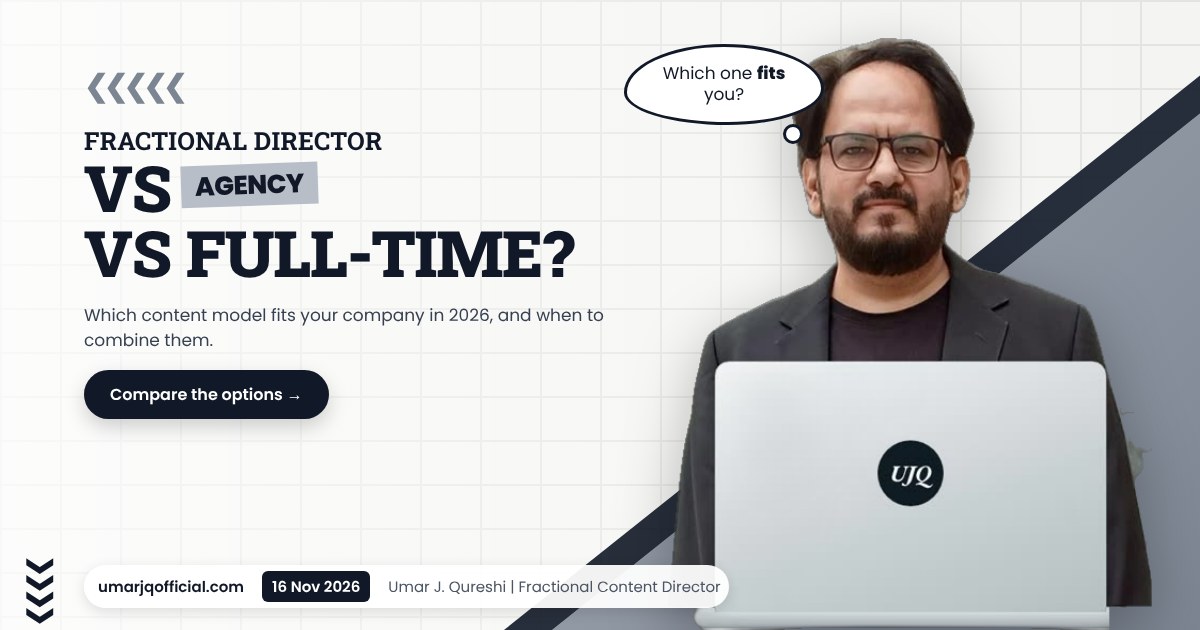
- A fractional content director owns strategy and standards, an agency produces to a brief, and a full-time head of content is permanent leadership headcount
- Most growing companies need direction before they need more production
- Many teams combine a fractional director with an agency or freelancers
- Choose by the problem you have: no plan, no capacity, or no permanent owner
A fractional content director owns your content strategy, standards and results part-time. An agency produces content to a brief. A full-time head of content is permanent leadership headcount. If your problem is “we don’t know what to publish or why,” start with a fractional director; if it is “we know, but can’t produce enough,” add an agency.
In more than 20 years of working on content, social media and PR for brands, nonprofits and executives, I have seen companies get this choice wrong in both directions: hiring an agency to produce more of the wrong content, or hiring a full-time executive before anyone knew what the job should be. Here is how to choose.
What is the core difference between the three options?
The difference is ownership. A fractional content director owns the decisions: audience, themes, channels, standards and measurement. An agency owns delivery of the assets you brief. A full-time head of content owns both, permanently, and usually manages a team. Each fits a different stage and problem.
| Fractional content director | Content agency | Full-time head of content | |
|---|---|---|---|
| Owns | Strategy, standards, results | Production to a brief | Strategy, team and results |
| Typical commitment | Monthly retainer, part-time | Project or monthly retainer | Salary, benefits, notice period |
| Speed to start | Days to weeks | Days to weeks | Often months of recruiting |
| Seniority | Senior by design | Varies by account team | Depends on budget |
| Biggest risk | Too few hours for a large program | Producing without a clear strategy | Expensive mis-hire, hard to undo |
| Best fit | Growing companies without a content leader | Companies with a clear plan but no capacity | Large, permanent content programs |
When is a fractional content director the right choice?
Choose a fractional content director when content is happening but nobody senior owns it: posts go out, but they are not tied to leads, the founder’s voice is missing, channels contradict each other, and agencies or freelancers need constant correction. It gives you leadership now without permanent headcount.
This is the most common situation I see with B2B companies in the USA and Canada. The Content Marketing Institute’s latest B2B research (Robert Rose, November 2026, 861 B2B marketers) found that 65% of marketers felt more pressure to produce content faster over the past year, while working with flat headcounts and more channels to feed; only 12% rated their marketing as highly effective. More output without direction rarely changes that number.
Fractional leadership is also becoming a normal hiring choice. Revelio Labs found that 24 of every 1,000 new executive job postings in 2026 were fractional, up from 9 five years earlier, with marketing among the largest categories after finance. I explain the role itself in what a fractional content director does.
When is a content agency the right choice?
Choose an agency when you already know your audience, message and goals, and the bottleneck is production: you need more articles, videos, designs or social posts than your team can make. An agency adds capacity quickly, but it works best with a clear brief from someone who owns the strategy.
Questions to ask before you sign:
- Who on your side will write and approve the briefs?
- How will you judge quality beyond “looks good”?
- Who decides what to stop producing when something is not working?
If nobody internal can answer those, the agency will make those decisions by default, usually optimizing for volume. That is where pairing an agency with a fractional director pays off. My checklist of questions to ask before hiring a social media consultant also works well for agency calls.
When is a full-time head of content the right choice?
Choose a full-time head of content when content is central to how you win customers, you have or plan several full-time creators, and you need a leader in daily cross-team meetings. The cost is real: the US median salary for marketing managers was $166,790 in May 2025, before benefits and recruiting.
A full-time leader makes sense once the program is large and stable enough to fill a full week of senior decisions. Many companies reach that point after a fractional director has written the strategy, built the editorial system and shown what works, which also makes the eventual job description far easier to write. Rates and budgets for the fractional option are broken down in how much a fractional content director costs.
Can you combine them?
Yes, and most growing companies should. The most efficient setup I see is a fractional content director who owns strategy and standards, directing an agency or freelancers who produce the work. Later, a full-time head of content can take over the system the fractional director built.
A typical progression looks like this:
- Stage 1: Direction. A fractional content director audits what exists, writes the strategy, sets up a content calendar and an approval process, and starts building the executive voice.
- Stage 2: Capacity. Freelancers or an agency are added, briefed against the strategy, and reviewed against clear standards. AI tools are used under a written AI content policy.
- Stage 3: Permanence (optional). If the program has grown enough, hire a full-time head of content, with the fractional director supporting the handover.
How do you decide in 10 minutes?
Answer three questions: Do we have a written strategy everyone follows? Do we have enough production capacity? Do we need a senior content leader in the building every day? No strategy means a fractional director; no capacity means an agency; a daily leadership need means a full-time hire.
| Your situation | Start with |
|---|---|
| No written strategy, content feels random | Fractional content director |
| Clear strategy, not enough output | Agency or freelancers |
| Strategy unclear and output low | Fractional director first, then add production |
| Large program, several full-time creators, daily cross-team decisions | Full-time head of content |
| Planning a full-time hire but unsure of the role | Fractional director to build and prove the system first |
How I work with companies at each stage
I work as a fractional content director for companies, founders and C-level executives in the USA, Canada and worldwide, and I am happy to work alongside your existing agency or freelancers. See the scope on my Fractional Content Director services page, compare all services, or book a free discovery call and we will work out which option fits where you are now.
Sources: Content Marketing Institute, B2B Content and Marketing Trends research, Robert Rose (November 2026); Revelio Labs, “Fractional executive roles” (September 2026); US Bureau of Labor Statistics, Occupational Outlook Handbook: Advertising, Promotions, and Marketing Managers (May 2025 data).
Frequently asked questions
What is the difference between a fractional content director and a content agency?
A fractional content director owns the strategy, standards and results of your content part-time. An agency mainly produces content to a brief. The director decides what to make and why; the agency makes it.
Can a fractional content director work with my existing agency?
Yes, and this is common. The director writes the strategy and briefs, reviews the agency's work against agreed standards, and reports results to leadership, so the agency spends its time producing rather than guessing.
When is a full-time head of content the better choice?
When content is central to your business model, you have or plan a team of several full-time creators, and you need a leader in daily meetings across departments. Many companies reach that point after a fractional director has built and proven the system.
Is a fractional content director cheaper than an agency?
They solve different problems, so compare scope rather than price alone. A fractional director's retainer pays for senior direction; an agency's fee pays mostly for production. Many companies spend less overall once direction stops wasted production.