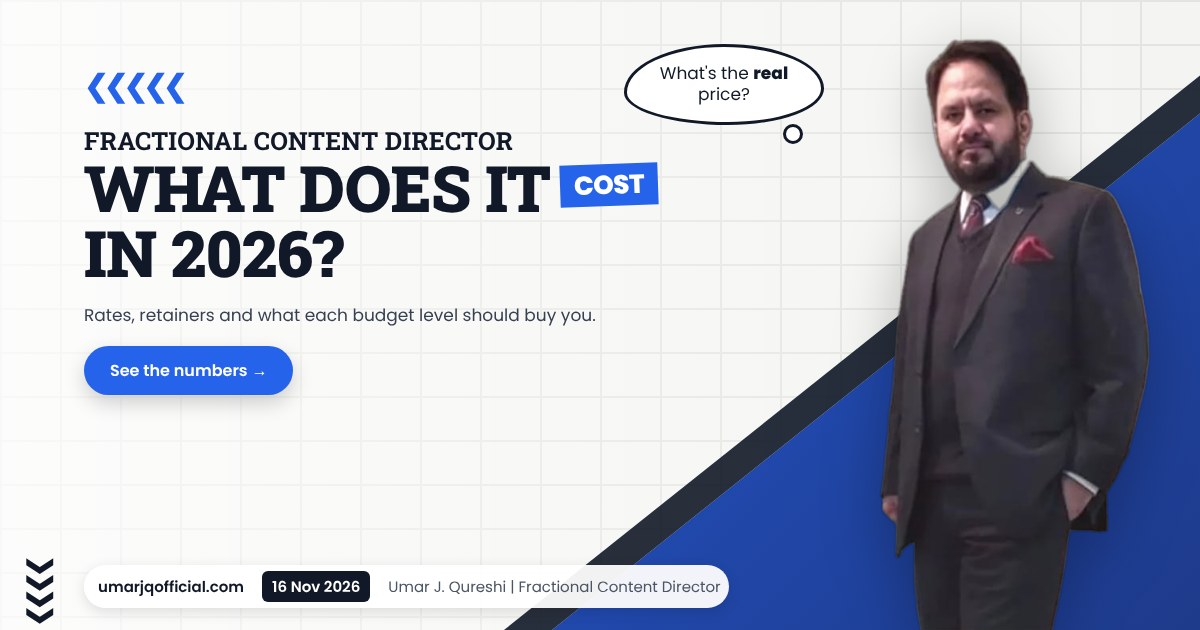
- US benchmarks put fractional content directors at about $155 an hour, with a middle range of $125 to $175
- At roughly 14 hours a week that is about $8,600 a month, but smaller scopes cost far less
- Compare it with a full-time marketing manager's $166,790 median salary before benefits and hiring costs
- Price the scope, not the hours: strategy, editorial system, executive voice and reporting are the parts worth paying for
A fractional content director in the US typically costs about $155 an hour, according to Go Fractional’s live benchmarks (November 2026). At around 14 hours a week, that works out to roughly $8,600 a month. Smaller, well-defined scopes cost much less, and the right price depends on what the role owns, not just the hours.
When founders ask me about price, the honest answer is “it depends on the scope,” but that is not helpful on its own. So here are the published benchmarks, what drives the number up or down, and what each budget level should actually buy you. If you are still deciding whether you need the role at all, start with what a fractional content director does.
What are the current market rates?
US marketplace data shows fractional directors of content marketing averaging $155 an hour, with the middle half charging $125 to $175. Typical engagements run about 14 hours a week, which puts the estimated monthly retainer at around $8,600, with a middle range of $7,000 to $9,800.
Those figures come from Go Fractional’s rolling 90-day benchmarks for the Director of Content Marketing role, last updated in November 2026. Go Fractional’s broader 2026 State of Fractional Work report puts the average fractional rate across all functions at about $153 an hour, and lists marketing among the most in-demand functions.
| Benchmark (US) | Figure | Source |
|---|---|---|
| Average hourly rate, fractional director of content marketing | $155/hr | Go Fractional, Nov 2026 |
| Middle 50% of rates | $125–$175/hr | Go Fractional, Nov 2026 |
| Typical hours per week | About 14 | Go Fractional, Nov 2026 |
| Estimated monthly retainer | About $8,600 ($7,000–$9,800 middle range) | Go Fractional, Nov 2026 |
| Median salary, US marketing managers | $166,790 a year | BLS, May 2025 data |
Marketplace benchmarks reflect what companies pay through that marketplace, so treat them as a reference point, not a price list.
How does that compare with a full-time hire?
A full-time content leader is a salary plus benefits, recruiting time and a long commitment. The US Bureau of Labor Statistics reports a $166,790 median annual wage for marketing managers (May 2025). A fractional retainer covers senior direction for a fraction of the week, and you can scale it up or down.
The salary is only part of the cost of a full-time hire. You also carry benefits and payroll taxes, the weeks or months spent recruiting, onboarding time, and the risk of a mis-hire at senior level. That is why many companies use a fractional director first: to build the strategy and the system, prove what works, and then decide whether a full-time role is justified. I compare the options side by side in fractional content director vs agency vs full-time hire.
What makes the price go up or down?
Five things drive the cost: how much of the week you need, whether the role includes hands-on production, executive and PR work, how many channels and markets are involved, and how much reporting and team management is expected. Strategy-only scopes cost least; full ownership with production oversight costs most.
- Hours and availability. A monthly strategy session plus async review is very different from weekly meetings with sales and leadership.
- Production. Directing an existing team or agency costs less than also writing, editing or producing the flagship pieces.
- Executive visibility and PR. Ghostwriting a CEO’s LinkedIn presence or pitching media adds senior hours. (See how executive personal branding on LinkedIn works.)
- Channels and markets. One audience on two channels is simpler than three products, five channels and two countries.
- Reporting and team management. Building dashboards, attending pipeline reviews and managing freelancers all take time.
What should each budget level buy you?
Whatever you pay, you should get a written strategy, a working editorial system, direction of the people producing content, and a monthly report in business terms. Higher budgets add more hours, executive content, PR and hands-on production oversight, not just more meetings.
A simple way to think about it:
- Starter scope: strategy, a content calendar, monthly direction of your existing writer or agency, and a short monthly report. Good for small teams that already produce content but lack direction.
- Growth scope: everything above, plus weekly involvement, executive LinkedIn content, a review of every key asset before publishing, and quarterly planning with leadership.
- Full ownership: everything above, plus PR and media work, management of several creators or agencies, and attendance at sales and leadership meetings.
My own retainers start from US$500 a month for a focused scope, and the scope decides where a specific engagement lands. If you want to estimate the production side separately, the free social media budget calculator helps, and my guide to social media management pricing in 2026 shows typical US and Canadian ranges.
How do you know it is worth the money?
Judge it by outcomes you can see within a quarter: a documented strategy, a consistent publishing system, a clear executive voice, and a monthly report showing which content led to conversations, leads or coverage. If none of those exist after 90 days, the engagement is not working.
This matters because content teams are under pressure. In the Content Marketing Institute’s latest B2B research (Robert Rose, November 2026, 861 B2B marketers), 65% reported more pressure to produce content faster over the past year, and 35% reported burnout or creative fatigue. Only 12% rated their marketing as highly effective, and just 9% named human resources as a top-three investment area for the year ahead. In that environment, paying for direction that makes existing effort count is often a better use of budget than paying for more output.
A quick 90-day checklist to hold any fractional content director to:
- Written strategy agreed by leadership (audience, themes, channels, goals).
- Editorial system in use: briefs, approvals, a shared content calendar.
- Executive voice guide, if founders or CEOs post.
- First two monthly reports, each with decisions, not just numbers.
- A short list of what you stopped doing, and why.
How I price my fractional content director work
I agree a fixed monthly scope after a free discovery call, so you know exactly what is included before anything starts. You can see what the role covers on my Fractional Content Director services page, compare all services, or book a free discovery call to scope it together.
Sources: Go Fractional, Fractional Director of Content Marketing rates (updated November 2026); Go Fractional, 2026 State of Fractional Work executive summary (June 2026); US Bureau of Labor Statistics, Occupational Outlook Handbook: Advertising, Promotions, and Marketing Managers (May 2025 data); Content Marketing Institute, B2B Content and Marketing Trends research, Robert Rose (November 2026).
Frequently asked questions
How much does a fractional content director cost per month?
Go Fractional's live US benchmarks (November 2026) estimate about $8,600 a month at the average rate and roughly 14 hours a week, with a middle range of $7,000 to $9,800. Narrower scopes, such as strategy and oversight only, cost much less.
What is the hourly rate for a fractional content director?
Go Fractional's benchmarks for fractional directors of content marketing average $155 an hour, with the middle half of rates between $125 and $175. Rates rise with seniority, industry depth and how much executive and PR work is included.
Is a fractional content director cheaper than a full-time hire?
Usually, for companies that need senior direction but not 40 hours a week of it. The US Bureau of Labor Statistics reports a $166,790 median salary for marketing managers (May 2025), before benefits, recruiting and management time.
What should be included in a fractional content director retainer?
At minimum: a documented content strategy, an editorial system, direction of your writers or agency, and a monthly report tied to business goals. Higher retainers usually add executive LinkedIn content, PR and more production oversight.