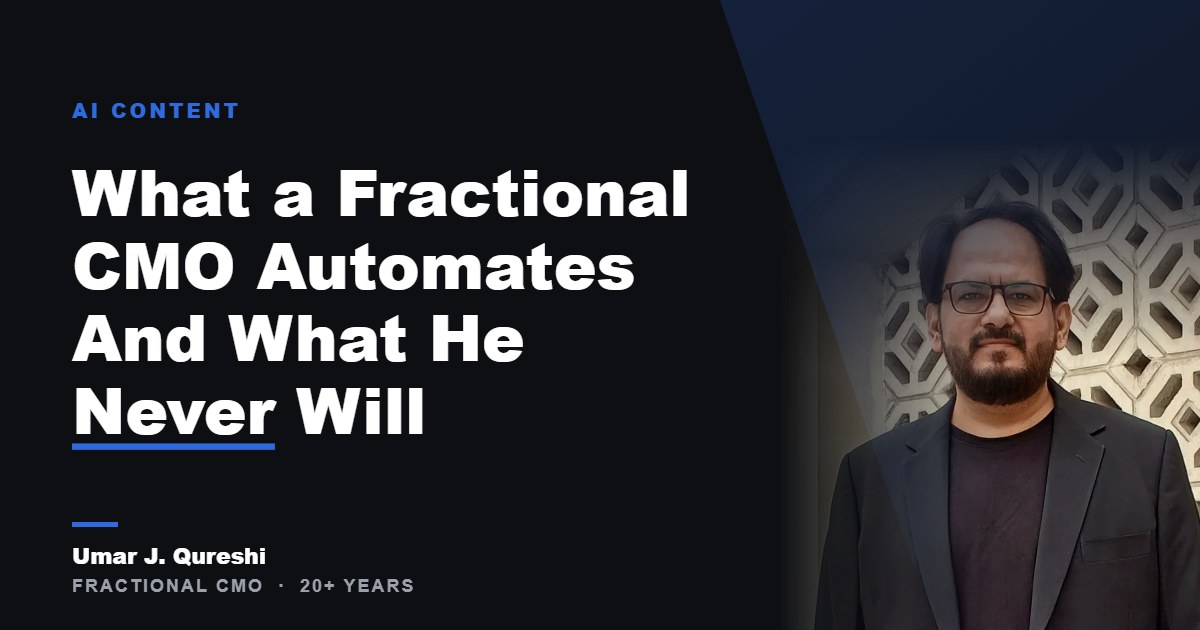
AI will not write your brand. It will write your drafts. I’m Umar J. Qureshi, a Fractional CMO with 20+ years in content creation, and I use AI every single day — which is exactly why I’m blunt about what it can’t do. Here’s where I let it run, and where I never will.
What AI is genuinely brilliant at
The blank page. Going from nothing to a rough draft used to eat the morning. Now it takes minutes. The draft is usually mediocre, and that’s fine — editing mediocre is ten times faster than inventing from scratch.
Reshaping. One long piece into a LinkedIn post, a script, a newsletter, an email. This is pure mechanical work and AI does it beautifully.
Volume research. Reading fifty competitor pages and telling me what they all say — so I can deliberately say something else.
The boring middle. Alt text, meta descriptions, FAQ variations, transcript cleanup. Nobody was enjoying that work anyway.
That’s a serious amount of a content team’s week, gone. I’m not romantic about it.
What I never hand over
The point of view. AI is trained on consensus. Consensus is what everyone already says. If you want to sound like every competitor, by all means let it decide what you believe.
The specific story. The client who nearly walked. The campaign that failed and what it taught you. The number from your own account. AI cannot know these, and these are the only things people remember.
The final read. Someone who understands the business reads every word before it ships. Every time. No exceptions.
Anything factual that isn’t checked. AI will state a wrong statistic with total confidence. It’ll invent a source. In regulated industries that’s not embarrassing, it’s dangerous.
The workflow I actually run
Extract, generate, cut, check, ship.
Extract — an hour of recorded conversation with the person who knows the thing. This is the raw material and it’s irreplaceable.
Generate — AI shapes that transcript into a structured draft. Fast.
Cut — I remove about forty percent. AI pads. It loves a three-item list and a tidy summary nobody asked for. Ruthless cutting is where the quality comes from.
Check — every number, name and claim verified against a real source.
Ship — with a human byline, because someone should be accountable for it.
Notice the expensive human time sits at the start and the end. The middle is where the savings are.
About disclosure
Be straightforward. If AI assisted, there’s no shame in it — this is a tool, like a camera.
What you don’t do is manufacture fake experience. Don’t have AI write a testimonial. Don’t invent a case study. Don’t claim a result you didn’t get. That isn’t an AI problem, it’s a lying problem, and it ends careers.
The real risk nobody talks about
It isn’t that AI writes badly. It’s that it writes acceptably.
Acceptable is the dangerous zone. It’s good enough to publish and not good enough to matter. Teams ship three times as much acceptable content, reach drops because the platforms can tell, and everyone blames the algorithm.
The algorithm is fine. The content got average.
So my rule: AI lets you spend less time producing and more time thinking. If you use it to produce more instead, you’ve made the problem worse with greater efficiency.
Want a content engine that uses AI properly — fast where it should be, human where it matters? Let’s talk.